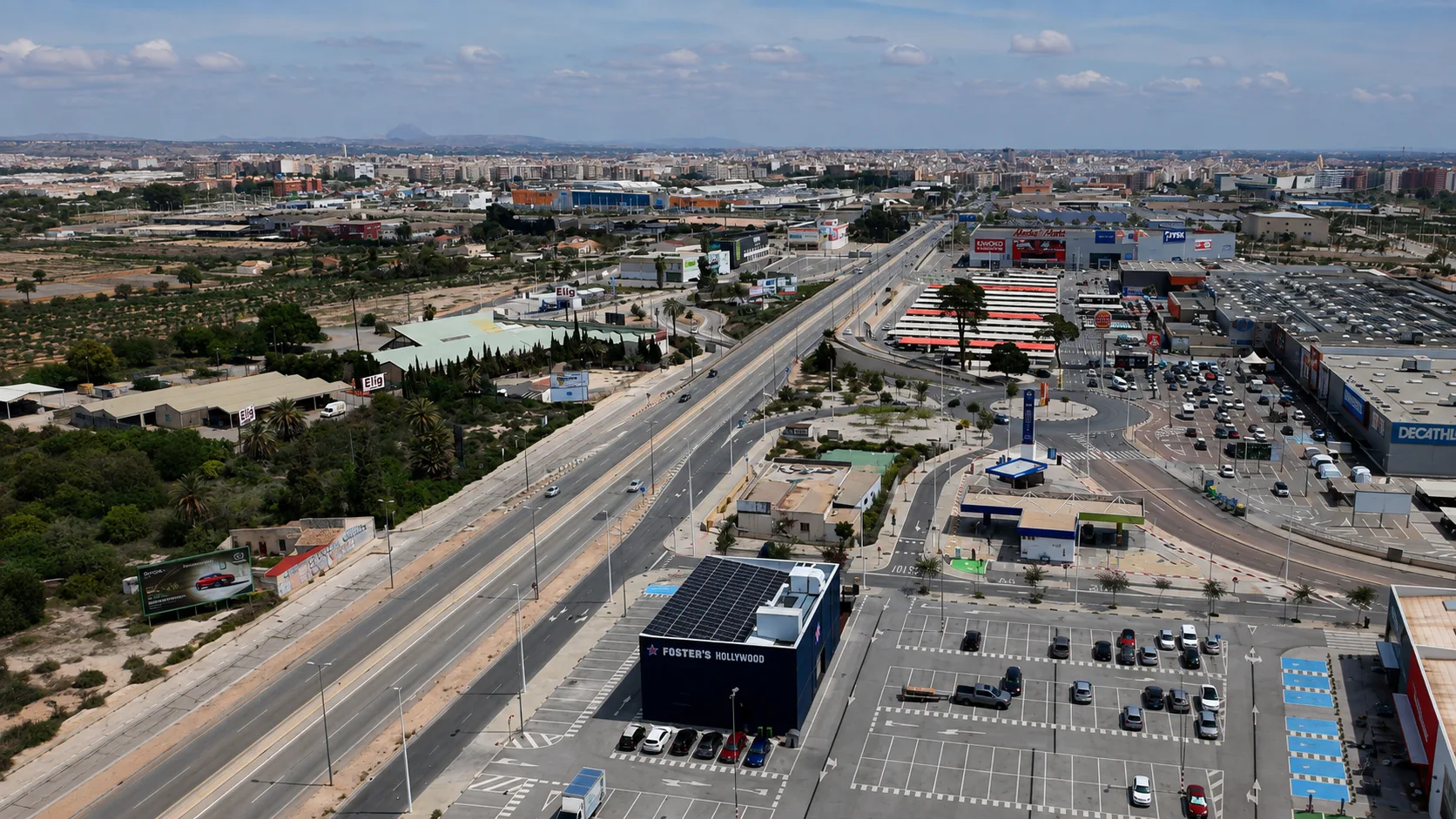
"It was all fields round here once"
And they weren't exaggerating
The western edge of Elche had a name of its own long before it had a single shopfront: Llano de San José, Pla de Sant Josep in Valencian. It is one of the rural districts of the Camp d'Elx, the farmland belt surrounding the city, lying between Elche and the neighbouring town of Crevillente. Scattered dwellings, irrigated and dry farmland, farmhouses, and a way of life tied to the old Alicante-to-Murcia road.
It should not be confused with the urban district of San José, in the Pla quarter, which sits inside the city beside the river Vinalopó. Two different places with almost identical names. The one this article is about is the rural one, out west.
The 1956 aerial survey leaves no room for argument. The whole western side of Elche, from the edge of the nineteenth-century extension out to the Crevillente municipal boundary, is effectively unbuilt: the odd wooded holding, a scattering of farmhouses, and fields all around.
One road crossed that landscape. And that road changed everything.
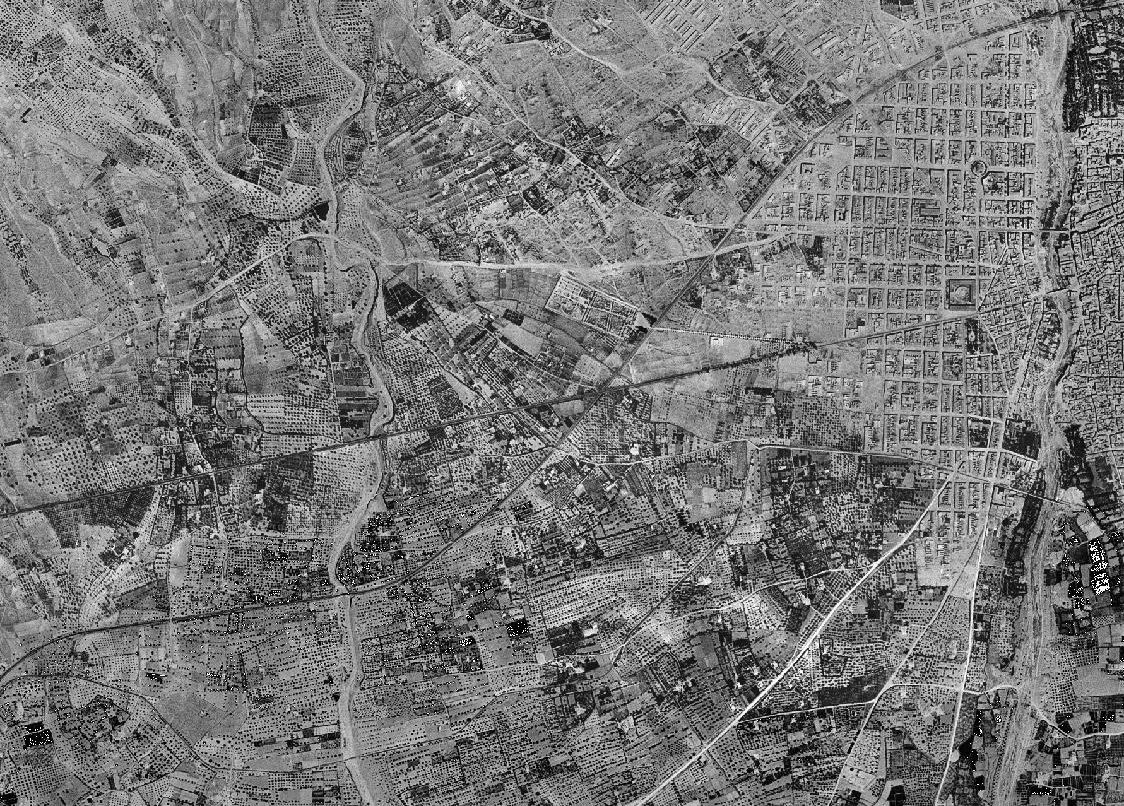
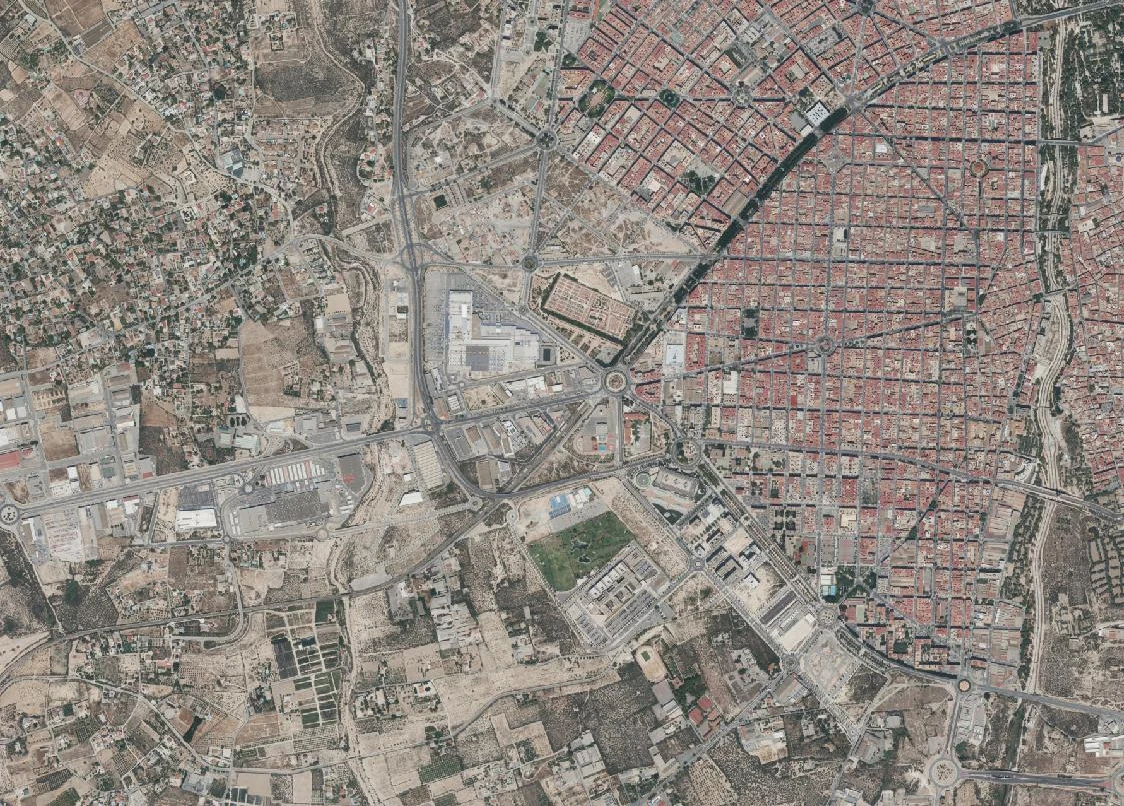
The same frame, seventy years apart. Drag to compare. Click to enlarge.
1956 (US aerial survey, IGN) versus 2023 (ICV). Drag to compare, ESC or ✕ to close.
A road inherited from the nineteenth century
The present-day Avenida de Crevillente, officially Avinguda de Crevillent, did not begin life as a street but as an intercity road. It descends from the Alto de las Atalayas to Murcia road, built in the second half of the nineteenth century to replace what is still known locally as the Camino Viejo de Crevillente, the old Crevillente track.
In time it was absorbed into the N-340, the great Mediterranean highway running from Cádiz to Barcelona. The stretch between Crevillente and Elche corresponds roughly to kilometres 710 to 722.
The official name has a history of its own. At the council session of 11 October 1940, as part of a wave of post-war street renamings, the urban stretch of the road was renamed Avenida del General Goded. That stretch is what is now Calle Antonio Machado, not the outer alignment we call Avenida de Crevillente today.
The current name, by contrast, rests more on custom than on any formal act: no document naming it officially has been traced, there is no street sign identifying it, and its far end is not clearly defined. A road almost two centuries old that the whole of Elche still calls by its old name. So much so that when the council delimited a development sector alongside it, the sector was christened E-29 "Carretera de Crevillente". The popular name won out over the official one.
Older than planning itself
One date is worth fixing before going any further. Spain's first Land Act was the Act of 12 May 1956 on Land Regime and Urban Planning, the first planning system to apply across the whole country.
In Elche, the first General Plan, the statutory master plan for the municipality, was approved in 1962 by ministerial order of 22 May. It was the first instrument to address the ordering and growth forecasts of the municipality as a whole.
Until then, expansion had been governed by extension plans and other partial instruments: documents that resolved one sector at a time, setting out streets, building lines, blocks and plot divisions, but without coordinating the city as a whole. Elche had several, among them Sebastián Canales's extension plan of 1924. The result was growth in pieces, one after another.
By the time a discipline for ordering cities finally existed, this road had been in service for a century and the Llano de San José was still farmland. The route predates the rules.
Industry first, retail afterwards
The area did not go from farmland to shopping in a single step. Roughly thirty years of something else came in between, and it was no minor phase: it was the phase that gave the land the shape retail would later occupy.
There were petrol stations, workshops, warehouses, car dealerships and, above all, footwear factories. On Calle Antonio Machado, at the edge of this area, Miguel Hernández Martínez, known in Elche as the Marqués de Carrús, ran a five-thousand-square-metre factory in the 1960s employing three hundred workers. He was the first major exporter of Elche footwear to the United States and at his height employed around a thousand people.
There was already a petrol station on this stretch by the early 1960s, where Gasolinera Mora stands today. Around it grew the workshops that lived off N-340 traffic, the roadside restaurants, and the industrial units chasing exactly what the big-box retailers would chase later: a large plot, vehicle access and visibility.
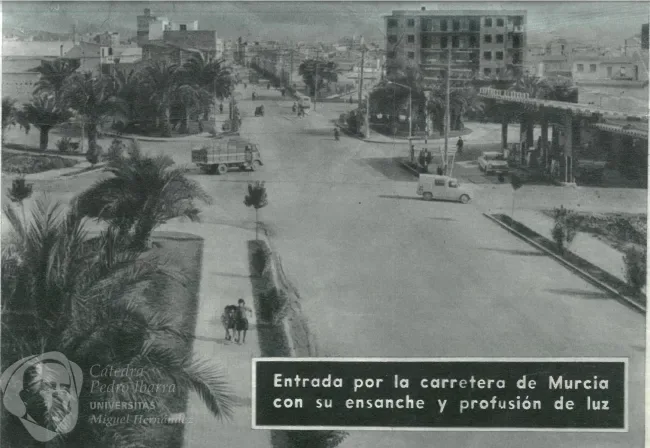
The Plaza de Crevillente roundabout on 1 April 1964, on the urban stretch of the road. On the right, the petrol station that already stood on the spot Gasolinera Mora occupies today. Source: Diario Información.
1973: the plan that got the direction right
Ten years before the hypermarket opened, Elche adopted a new General Plan, in force from 24 October 1973. That plan had a clear idea of where the city should grow.
It proposed linear growth east and west, anchored on the major transport corridors: the Alicante-to-Murcia road, the motorway, the dual carriageway and the railway. The intention was to extend the city lengthwise from the existing core so as not to encroach indiscriminately on the Camp d'Elx. A central spine of civic and commercial uses, running along the Avenida del Ferrocarril, was to hold the whole thing together.
Put another way: the westward direction of growth had already been set out a decade before Continente arrived. The hypermarket did not create the corridor. It landed on a route that planning had already identified as the backbone of the city's expansion.
The plan got the direction of growth right, but not the kind of city that would end up being built along it.
It envisaged a linear city ordered by infrastructure and designed to protect the farmland. What arrived instead was car-dependent peripheral expansion, with big-box retail and looser urbanisation. One caveat is worth stating: to assert that Continente's exact site was designated for growth, the original plan drawings would have to be consulted, not merely the historical summaries.
12 April 1983: Continente opens
That day the Continente hypermarket opened, the eighth in the chain in Spain. The advertising placed it less than five minutes from Crevillente and under a quarter of an hour from Alicante.
It is worth understanding what it actually was, because it bore little resemblance to what stands there now. What opened was the hypermarket, parking for two thousand vehicles, and an in-house restaurant: first Gofy and later Nostrus, the two catering brands of Promodès, Continente's parent group. The same group owned the Feu Vert car workshops, which would end up inside the complex itself, attached to the hypermarket and reached from within it. That restaurant unit is now occupied by a Popeyes.
What mattered was not the building but what it set off. A facility on that scale generates journeys of its own: people getting in the car on a Saturday from Elche, Crevillente, Matola and the western hamlets with a single destination in mind. The road stopped being somewhere you drove through and became somewhere you drove to.
A family outing at the weekend. Because the hypermarket was not just somewhere to shop: it was a day out, near enough a plan.
Anyone who grew up here in the eighties and nineties remembers it. The big Saturday shop. Coins spent on sweets. And above all the seasons: school supplies in September, toys and presents at Christmas, when the toy aisle became an expedition in itself.
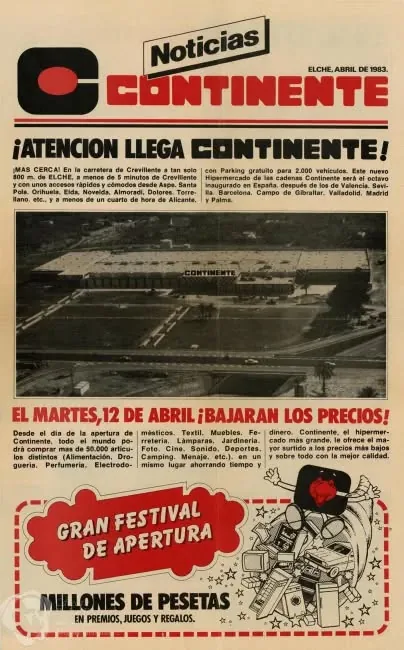
Front page of "Noticias Continentes" announcing the opening on 12 April 1983. Source: Cátedra Pedro Ibarra, Universidad Miguel Hernández.
Twenty years without a second major anchor
Here is the part of the story that rarely gets told, and it is the part that explains the rest. Twenty years passed between Continente in 1983 and L'Aljub in 2003. Throughout those twenty years the Carretera de Crevillente was not yet a continuous retail corridor: Continente was its only major shopping destination, surrounded by an urban-fringe landscape.
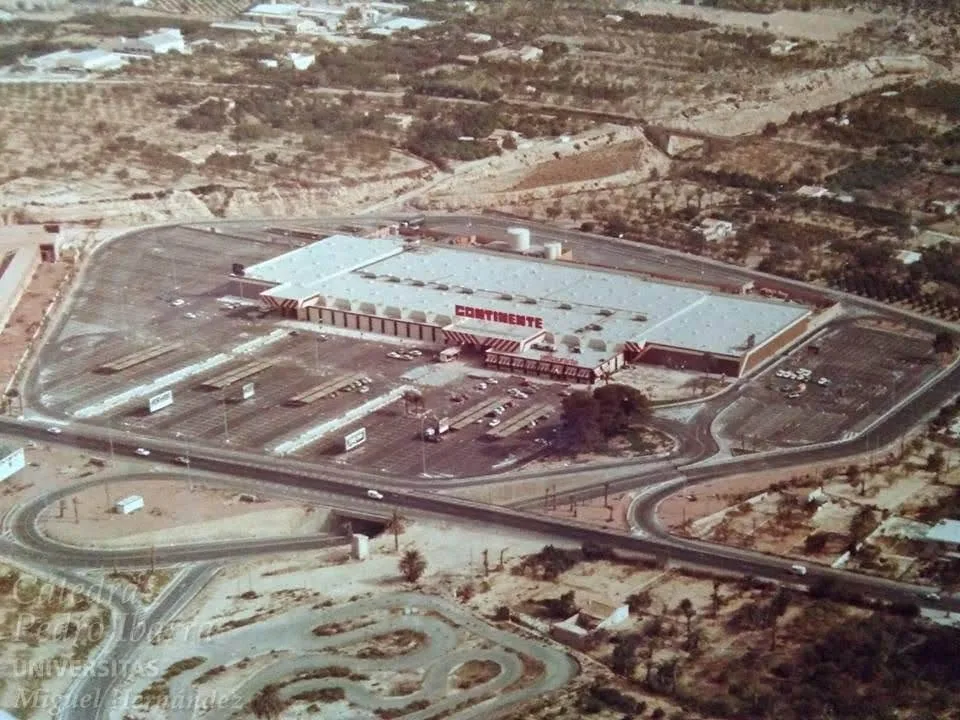
The Continente hypermarket, isolated on the edge of the city. The aerial photo shows the scale of the site and its solitude in the landscape. Source: Cátedra Pedro Ibarra, Universidad Miguel Hernández.
Around it a scattered mix of activity persisted: industrial units, workshops, factories, petrol stations, vehicle sales and repair, car dealerships, joinery, furniture, lighting, electrical goods and roadside catering. Businesses geared to passing traffic and to the car, not to the weekend shop.
The transformation was slow and, above all, physical. Servicing land costs more than opening shops. The documentary traces of that process speak for themselves:
- The council levied betterment charges for partial works of ordering along the Carretera de Crevillente. In other words, the route was no longer treated purely as an external road: works were being funded to give it urban form.
- At the session of 28 February 1989, work began on the special infrastructure plan for the Cemetery district, between the Camino Viejo de Crevillente and Calle Joaquín Martínez Maciá: potable water supply, sewerage, treatment and reuse of wastewater.
- On 26 June 2000, the Partial Plan for sector E-29, "Carretera de Crevillente", was approved, setting out its land-use regime, specifically covering the area around Continente and the Barranco de los Arcos.
The same area contained Distribution Area 96, a component of the 1998 General Plan tied to the development of sector E-29. Its provisions opened the way to new retail floorspace, roads, open space and community facilities. In the early 2000s, servicing works in the area were proceeding at the same time as an extension to Carrefour was being considered.
That detail helps convey the commercial mood of the period. Before L'Aljub opened its doors with shops, restaurants and a cinema under one roof, the idea that the area around Continente and Carrefour might grow into a major shopping and leisure destination was already circulating among landowners, traders and people connected with the area. Some recall talk of putting a multiplex cinema there.
The recollection captures the spirit of those years well: Carrefour was no longer seen simply as a hypermarket, but as the possible core of something larger. That model was eventually realised at L'Aljub, approved in 1993 and opened in August 2003: the city's first large retail complex to bring together, on that scale, shops, restaurants and a multiplex.
Seventeen years between the hypermarket opening and the approval of the planning that ordered its immediate surroundings. That figure sums up the real pace of events better than any explanation.
Another General Plan came and went in between, approved on 30 July 1986 and later replaced in full by the 1998 plan, during years in which the western edge of Elche was beginning to be treated as urban territory.
All of this was happening while the hypermarket had already been trading for more than a decade. Continente had become a local institution before anything resembling a retail corridor existed around it.
From Continente to Carrefour
For several generations of Elche residents that building was never "the hypermarket": it was el Continente first and el Carrefour afterwards. In other Spanish cities the equivalent was el Pryca, and the two brands eventually merged.
The deal was announced on 30 August 1999, when Carrefour agreed to absorb Promodès, Continente's owner. The rebranding reached Spain in 2000: Pryca and Continente both became Carrefour, with the new name formally adopted that September.
The sign changed. The reference stayed attached to the place.
More than forty years filling the avenue
Continente worked as a magnet. But the corridor is not a single site, and the pieces are worth telling apart: the big-box stores that wanted cars, parking and visibility took frontage directly on the avenue; L'Aljub is an enclosed shopping centre under single management; and El Sauce is a self-contained retail park, far more recent, which grew out of the Continente area itself, next to sector E-29. That spot is where the whole corridor began.
There is little to suggest those arrivals answered to any single overarching scheme. Each came with its own developer, its own timetable and its own commercial logic. The corridor was never designed. The corridor happened.
The scale of the road
The avenue is between forty and forty-six metres wide, with dual carriageways and service roads along most of its length. That is not the cross-section of an urban shopping street: it is an adapted highway, with capacity for through traffic and separate access for every plot.
It is precisely the support that big-box retail requires, and it was there before any of it arrived.
The first two figures come from council reports as carried by the local press. The last two are commercial estimates, useful as an order of magnitude rather than as official statistics.
A timeline of the corridor
And the traffic arrived on cue
There is one thing about those years that nobody misses and that genuinely existed: you could get there without queuing.
Every part of the corridor set up chasing the same flow of customers, and all of them ended up discharging it at the same point. The L'Aljub roundabout is now one of the busiest spots in Elche, because almost every access is concentrated on the southern and eastern sides of the retail complex. The shopping centre opened in 2003. Works to reorganise its surroundings were approved in July 2026. Twenty-three years to put forward a solution that has yet to be built.
Planning arrived late to the corridor
The 1998 General Plan designated these sectors as predominantly industrial; the land-use regime for sector E-29 is set by its Partial Plan, approved on 26 June 2000, which develops the General Plan's zoning. When that regime was approved, Continente had already been trading for fifteen years. Twenty-eight years later, on 30 April 2026, the council announced the start of Amendment no. 48 to the General Plan, which proposes making retail and services the predominant use across eight sectors of the corridor, E-29 among them.
Seventy years along one road
Four general plans have passed over this route: 1962, 1973, 1986 and 1998. Each one found it as something different. Farmland with a road running through it. Industry and workshops. A hypermarket serving the surrounding district. A retail corridor of two hundred businesses.
The road was always ahead. That is what happens when a piece of infrastructure is older than the discipline meant to order it: the route was already there, with its access and its visibility, and activity kept arriving to find it, decade after decade, without waiting for anyone's permission.
Nor is the sequence unique to Elche: industry seeks cheap land on the edge, the city grows and catches up with it, and that land, no longer on the edge but in an excellent location, is transformed. Elche lived it out in its own idiom. The industrial units of the 1960s along the Carretera de Crevillente, footwear chief among them, ended up surrounded by retail, and some changed trade without moving an inch. It cannot be explained solely as a failure of planning in Elche: it is the story of almost any Mediterranean urban fringe.
Of all that farmland, little fully serviced development land remains on the front line today. Behind it there is still land, and more will come forward, because the corridor still has room to grow inwards. Facing the N-340, though, the front line filled up as operators arrived. At sector E-29, opposite Carrefour, some is still there: the very spot where it all began in 1983.
Someone drew a road towards Crevillente in the nineteenth century. Everything else followed behind it.
Specialises in non-developable land in the Valencian Community: territorial impact mitigation, declarations of community interest, and environmental and landscape assessment.
Frequently asked questions
01 What was the Avenida de Crevillente in Elche called before?
Popularly, Carretera de Crevillente, a name inherited from the intercity road to Crevillente that was later absorbed into the N-340. In 1940 the urban stretch was renamed Avenida del General Goded, today Calle Antonio Machado, but the popular name never went away. The current name rests on custom: there is no street sign identifying the road.
02 When did the Carrefour in Elche open?
On 12 April 1983, under the Continente name, as the chain's eighth hypermarket in Spain. It opened with parking for 2,000 vehicles and an in-house restaurant run by the Promodès group, first Gofy and later Nostrus. It became Carrefour in 2000, after the two brands merged.
03 What was there before, where Carrefour now stands?
Farmland, specifically the Llano de San José district, and from the 1960s onwards petrol stations, workshops, footwear and cardboard factories, warehouses and car dealerships.
04 How long did it take the Carretera de Crevillente to become a retail corridor?
Twenty years from the opening of Continente. Between 1983 and 2003, when L'Aljub opened, the hypermarket was the corridor's only major anchor, surrounded by industrial units, workshops, car dealerships and roadside catering. The Partial Plan for sector E-29 was not approved until 26 June 2000.
05 Was the Llano de San José part of the Camp d'Elx?
Yes. The Llano de San José, Pla de Sant Josep, is one of the western rural districts of the Camp d'Elx, lying between the city and Crevillente. It should not be confused with the urban district of San José, which sits inside the city beside the Vinalopó.
06 When did the L'Aljub shopping centre open?
In 2003. El Corte Inglés opened its own store near the corridor in 2007.
07 Why does the council want to change the land use on the Carretera de Crevillente?
Because the 1998 General Plan classified the corridor as predominantly industrial and the Partial Plan for sector E-29, approved on 26 June 2000, kept industrial as the characteristic use, while the reality was already commercial. Amendment no. 48, begun in April 2026, proposes making retail and services the predominant use across eight sectors of the corridor.
Sources
- Cátedra Pedro Ibarra (Universidad Miguel Hernández). Memoria Digital de Elche/Elx [online]. Elche. Available at: elche.me [Accessed: August 2026]. Entry on the Avenida de Crevillente, the 1983 opening of Continente and historic businesses.
- Elche City Council. Municipal archives and minutes. Session of 11 October 1940 (street names); session of 28 February 1989 (special infrastructure plan for the Cemetery district); approval of the Partial Plan for sector E-29 on 26 June 2000 (municipal certificate). Open government portal: elche.es.
- Elche City Council. Amendment no. 48 to the General Plan. Notice of commencement, 30 April 2026. Traffic reorganisation around the L'Aljub roundabout and SIG-Elx geographic information system.
- Diario Información (Alicante) and Alicante Plaza. Reporting on the corridor's commercial consolidation and the progress of the planning amendment. informacion.es · alicanteplaza.es.
- Instituto Geográfico Nacional (IGN) and Institut Cartogràfic Valencià (ICV). 1956-57 aerial survey and current orthophotography (PNOA). ign.es · icv.gva.es.